

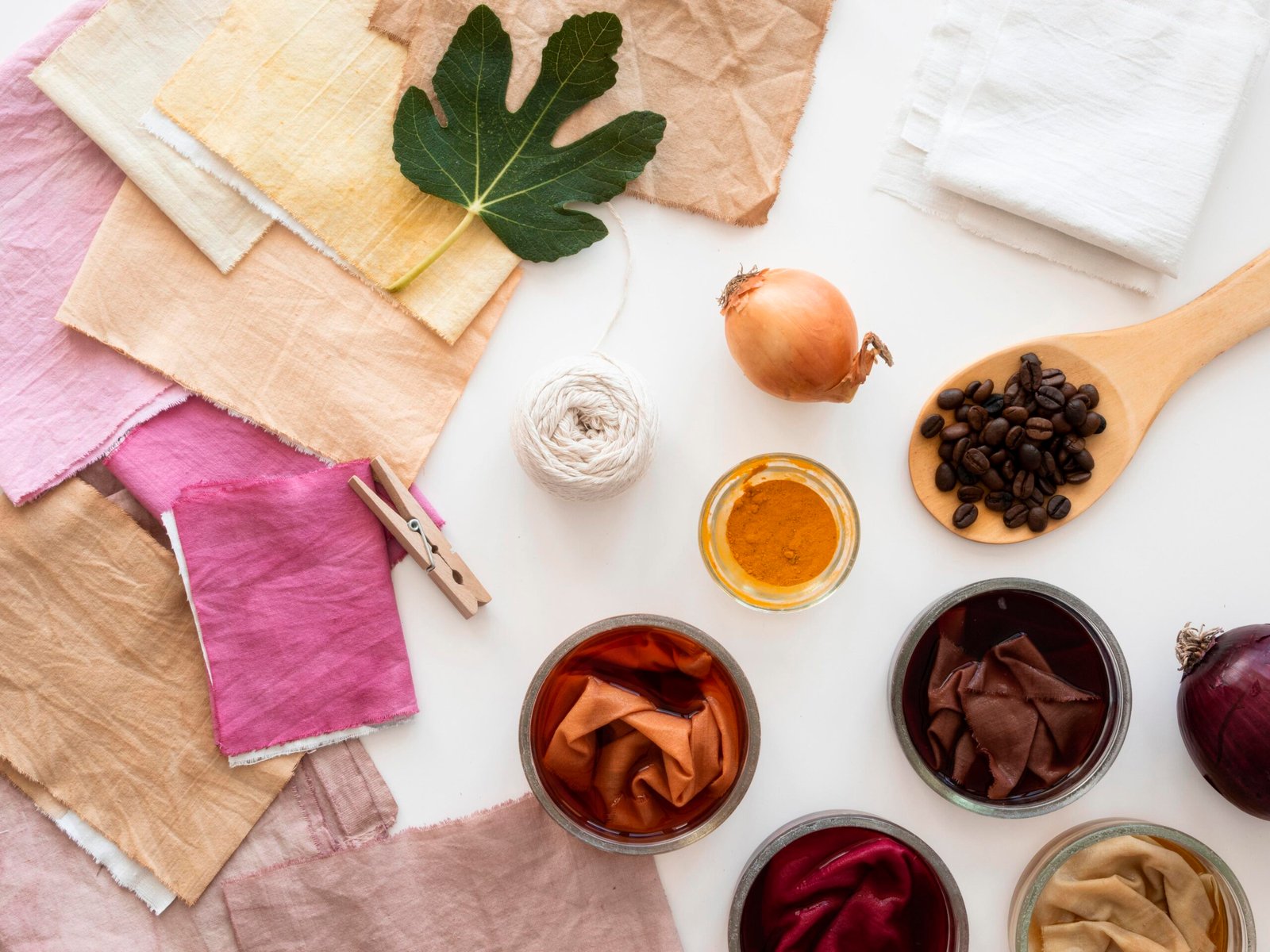
For centuries, the question of colour has been an important one of fashion. It can make or break the impression left by a textile and its design but also reflect a culture, an emotion, and leave a memorable impression made memorable.
But up until the time that modern, artificial colours were created, fashion paid homage to nature for its ability to provide a variety of beautiful colours used by people.
Flowers, leaves, roots, bark, fruits, seeds and even everyday natural materials were used by people in generations past to create beautiful shades for clothes.
Natural dyes are becoming interesting again in the modern day, for their connection to sustainability, tradition, craftsmanship, and conscious textile creation.
But what exactly makes natural dyes special ingredients? Where can these beautiful colours come from? How could a simple plant, be it turmeric, indigo, or a fruit peel become a beautiful natural colour for fabric?
Let us learn to love the wonderful world of natural dyes and their connection to nature, the craft and colour!
From Nature, To Your Clothing: The Story of Natural Colours
When looking at a finished piece of clothing, it can be easy to forget the history behind the bright red shade, or the soft yellow. But all colours have a story!
With natural dyes, these stories can often run right from the roots of a plant to the fabric of your clothes.
For, it can be any part of a plant that can provide the source of its colour: the root, the flower, the leaf, the bark, the fruit, or the seeds.
It takes patience, knowledge, and often, skill to turn each of these ingredients into a dye bath ready to colour and change a piece of textile forever.
Naturally dyed fabric, therefore, is the product of not only the connection between natural materials and fabric but the skill of textile workers paid to extract their colours.
Why Are Natural Dyes Becoming Interesting Again?
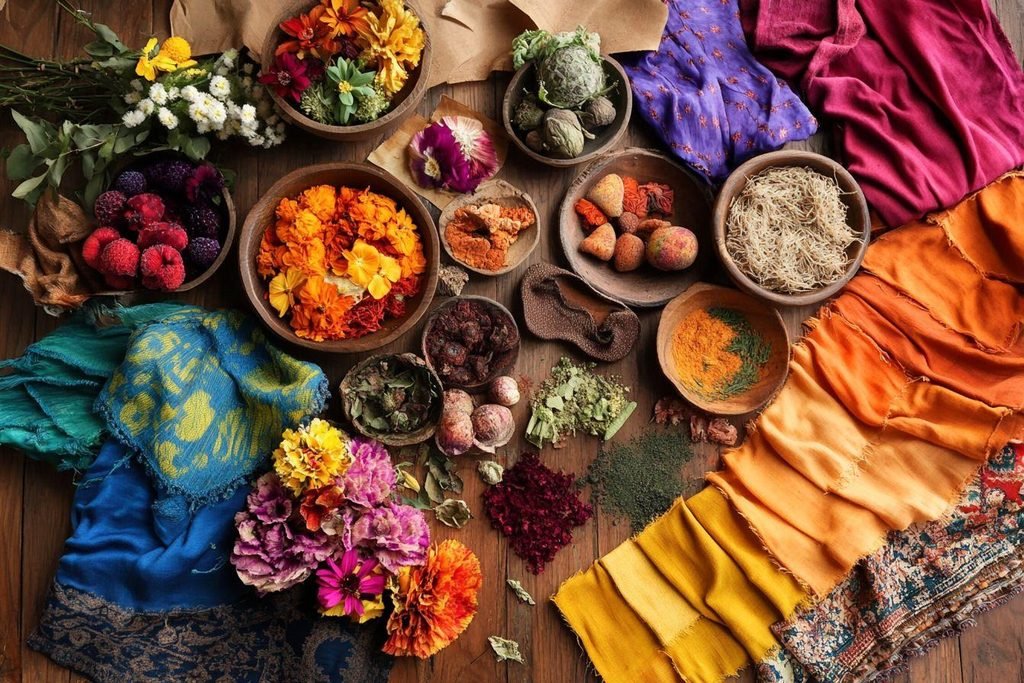
The world of fashion is changing dramatically.
People are becoming more and more interested in what materials their clothes are made of, how are they manufactured, and what is their story.
Hence natural dyes are becoming more interesting to the modern world and its connection to sustainability, tradition, and conscious textile production, with natural dyes offering the possibility to experiment with colour using biodegradable sources.
But there is yet another reason why the interest in fabric dyed with natural colours is growing: natural dyes offer variation!
By relying on plants, you never know what colour you will get from a batch of fabric you dye with its roots, leaves, flowers or fruit.
Variation may seem like a negative trait, but by embracing this characteristic of natural dyes, we embrace the opportunity to create a piece of clothing that is unique and different!
Nature’s Colourful Offerings Are More Interesting Than You Know!
One of the most fascinating things about naturally dyed textiles is the sheer variety of plant materials that can be used to colour fabric.
Not every interesting dye source is rare, however, and some can be used even by those just becoming familiar with the natural dye process.
Turmeric: A Natural Golden Yellow!
Turmeric is one of the most easily accessible natural sources of yellow!
The rhizome of this plant contains curcumin which gives turmeric its distinct yellow-orange hue.
In dyed textiles, turmeric can create beautiful yellow and golden shades, making its root a perfect reminder that the most common things in nature are also capable of surprising us with their beauty!
Indigo: The Most Interesting Natural Blue
Few things in nature possess such striking shades of blue as indigo plants.
Indigo dyeing process offers fascinating insight into the way natural dyes work, as the colour changes dramatically when exposed to air.
What is more, when one looks at fabric removed from a dye bath, its intense blue hue will hardly remind one of the deep indigo of the finished textile!
Madder Root: Creating Vibrant Reds
Madder has long been used by textile workers to create red hues.
The roots of this plant contain compounds that can be used to dye fabric in red, terracotta, orange-red and similar shades.
The deep, rich tones found in madder-dyed textiles have made it a popular natural dye.
Marigold Flowers: A Way To A Sunny Yellow!
Marigold flowers add yellow and golden hues to naturally dyed textiles.
It is fascinating how the short life of a flower can be used to create beautiful shades of yellow!
But the ability to create striking colours using flowers is not always easy, as it requires both the right type of blossom and a dyeing technique to extract its colour.
Pomegranate Peels: Turning Waste Into Colours!
Using natural dyes can often mean creating opportunities for recycling!
For example, pomegranate peels contain tannins and other compounds that can be used to dye textiles yellow, beige and brown hues.
This means that instead of throwing away pomegranate peels after squeezing their juices, one can use them to create a dye bath and colour fabric!
Onion Skins: Turning Kitchen Waste Into Colours!
Thin, papery onion skins may seem like a nuisance, but they can be an easy way to create beautiful golden and amber shades.
Onion skins can create another interesting opportunity for those who want to learn more about natural dyes and textile recycling!
Leaves, bark, fruits, seeds…
Leaves, bark, fruits, and seeds are just some of the objects that can be used to create a textile colour.
Depending on the plant, different parts can yield different results: leaves can give yellow, green or earthy tones, bark and trees can provide brown, tan or red shades, and fruits and fruit skins contain compounds which can also be useful for dyeing.
Seeds and roots can also contain dyes!
Hence, the opportunities for experimentation with natural dyes are endless!
How Does A Natural Dye Become A Beautiful Textile Color?
The creation of naturally dyed textiles can be a long and complex process.
Depending on the dye used, a number of preparatory steps must be taken to prepare a piece of fabric and the dye itself.
The actual ingredient used to create colour may need to be cleaned, dried, cut into small pieces or crushed before its colour can be extracted and placed into a dye bath.
In addition, the fabric may need to undergo special preparation in order to better receive the dye, for example, using mordants to alter its properties.
The textile is then placed in such a dye bath, where the colouring process begins before the fabric is washed and dried.
Each step in this process can influence the final result, which is why the same dye may produce different results with different pieces of fabric or, at times, an unexpectedly beautiful outcome!
Why Isn’t My Naturally Dyed Fabric The Same As The Last One?
One of the most fascinating characteristics of natural dyes is the possibility to create truly unique pieces.
Fabric dyed with the same ingredients can vary, producing differing results every time.
But why is that so?
Because natural dyeing is a complex process involving a number of variables:
The properties of the natural dye ingredient
The season and conditions of growth
The type of textile fibre
The characteristics of the water used
The concentration of the dye solution
The temperature
The length of the dyeing process
The preparation of the fabric
Mordants and other additives
Drying conditions
Every combination can yield different results, with the differences being especially prominent for handmade textile production.
But why is this such a big deal?
For mass production, this can be seen as a negative quality, but the opportunity for variation inherent to many natural dyes is what makes handcrafted textile production so fascinating!
Natural Dyes Isn’t Necessarily Sustainable
There is one more important detail regarding natural dyes: the fact that not every natural dye is sustainable.
While most plant-based ingredients are not as harmful to the environment as synthetic dyes, their impact should not be ignored.
For example, in the case of irresponsible plant harvesting, natural dyeing can have negative consequences for ecosystems.
Therefore, it is vital not to forget about the big picture when using natural dyes.
Sustainable fashion means looking at the entire process of textile creation: where the ingredients come from, how are they treated, how much water and energy is spent on processing, what other additives are used and what happens to the resulting wastewater.
Naturally dyed textiles, therefore, require special responsibility when it comes to sustainability.
Natural Dyes & The Future Of Fashion
Fashion looks to the future: but its best ideas often come from the past and present.
Natural dyes, the art of creating fabric colours using natural ingredients and traditional methods, are one such example.
Naturally dyed clothes serve to unite people and remind them that sustainable, conscious textile production often requires alternative methods and materials.
At the same time, it inspires reflection on the materials and processes used, making these items of clothing memorable not only for their design but for their story.
In a world that often puts quality materials and production speed over slow and steady production, natural dyeing inspires us to remember that fashion should last!
Maayon Fashion: Learning To See The Story Behind The Textile!
At Maayon Fashion, we like to see beauty in all things, but especially in those that are close to nature.
Naturally dyed clothes open up new possibilities to learn about the story behind the textile.
From the golden yellow of turmeric, to the deep blue of indigo, from marigold flowers to leaves, root, bark, fruit and fruit peels – nature has countless opportunities to surprise us with its beautiful colours!
The beauty of it all lies in the fact that these materials can inspire us to create beautiful things using our skills, knowledge and the patience needed for textile dyeing!
A More Interesting View On Colours!
The next time you see a nice piece of fabric dyed in beautiful colours, learn to stop and look at it differently.
Look at the colours.
Look at the materials that made it possible.
Look at the hands that worked to create it.
Look at the nature that inspired its creation.
Natural dyes remind us that fashion does not always need to be manufactured to be inspiring.
Sometimes it can come right from the plants and materials that surround us.
A flower.
A leaf.
A root.
A seed.
A fruit peel.
And turning nature into fabric requires no less than the skill and patience of a textile worker!